
Showing the single result
Filter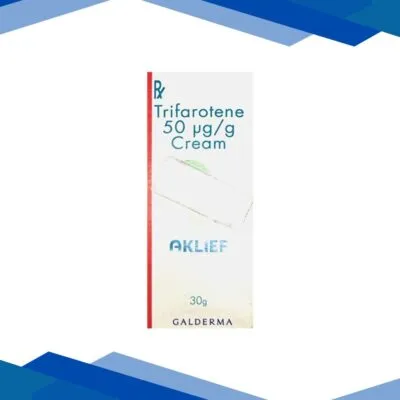
Trifarotene 0.005% Cream: uses, side effects, price, and substitutes
Trifarotene is a newer prescription topical retinoid that is mostly used for moderate-to-severe acne vulgaris on the face, and/or the trunk (chest, shoulders, and back) for people 9 years old and up. It’s often described as a targeted fourth-generation retinoid molecule, meaning it works in a more focused way, helps eliminate acne spots quickly, but still keeps an optimized safety profile on broader skin areas. Basically, it targets the problem without spreading itself everywhere as much.
Retinoid evolution: how trifarotene works
Older topical retinoids (like Tretinoin or Adapalene) can interact with multiple retinoic acid receptor subtypes in the skin. That includes RAR-$\alpha$, RAR-$\beta$, and RAR-$\gamma$. Trifarotene is considered a clinical step forward because it is more selective.
Targeted RAR-$\gamma$ agonism: Trifarotene works mainly as a specific RAR-$\gamma$ (gamma) receptor agonist. The gamma receptor is among the most dominant retinoic acid receptors in the human epidermis (the outer skin layer).
Gene modulation effects: once it binds primarily to RAR-$\gamma$ it changes how certain downstream genes behave, especially those tied to cell turnover. It downregulates dystonin, which weakens the cellular “grip” that keeps dead skin cells stuck together.
Comedolysis and anti-inflammation: that chain reaction helps stop tiny clog formations (microcomedones), supports a faster cell turnover so existing blockages can clear, and reduces pro-inflammatory pathways that contribute to painful, red pimples. Since it avoids heavy activation of RAR-$\beta$ receptors, which are commonly linked to deeper irritation, Trifarotene can be used on bigger zones like the trunk, with less concern about systemic toxicity.
Primary uses and benefits
Facial acne vulgaris: reduces whiteheads, blackheads, and inflamed pustules on the face.
Truncal acne management: it has been evaluated for and approved for widespread stubborn acne on the chest, shoulders, and back.
Skin texture refinement: by encouraging more balanced cellular turnover, it may help reduce post-inflammatory hyperpigmentation (acne marks) over time, and support smoother skin texture as scarring fades.
Application protocols and dosage guidelines
Trifarotene is strong, so a small quantity is usually enough.
Cleanse: wash the affected areas gently using a soap-free mild cleanser. Pat fully dry. Do not apply on damp skin, or right after washing, because extra water can speed up absorption and can intensify peeling.
Evening routine: use it one time each day, in the evening, before sleep.
Pump measure rule:
- 1 pump: enough to spread a thin layer across the entire face (forehead, cheeks, nose, and chin). Avoid the corners of the mouth, eyes, and nostrils.
- 2 pumps: enough to cover the upper trunk (shoulders, chest, and upper back).
- 1 extra pump: sometimes used for the middle and lower back areas if acne keeps showing up there.
Moisturizer buffer: to limit typical retinoid flaking, apply a non-comedogenic moisturizer right after the cream absorbs.
Potential side effects and skin adaptations
Like other advanced retinoids, Trifarotene can cause predictable adjustments early on, often called the “retinization” phase.
Common localized reactions (usually strongest within the first 4 weeks):
- Skin erythema (redness), plus flaking or scaling
- Mild to moderate burning, stinging, or tingling
- Localized itching and dryness
- Faster sunburn risk because the stratum corneum thins
Adverse reactions (stop and contact a dermatologist):
- Severe, unbearable burning or blistering
- Oozing, crusting, or cracking that bleeds
- Severe contact allergic dermatitis
Safety and daily care advice
Parameter | Clinical status | Medical care guidance
Sun exposure ⚠️ High photosensitivity
Trifarotene can make UV exposure more intense. Use SPF 30+ non-comedogenic sunscreen every day.
Pregnancy ❌ Strictly contraindicated
Even if systemic absorption is low, topical retinoids can still pose risk during pregnancy. Don’t use if pregnant or actively planning pregnancy.
Hair removal ❌ Avoid waxing
Retinoids thin the outer barrier. Waxing can cause epidermal tearing, irritation, or scarring.
Skincare routines ⚠️ Use caution
Avoid using strong astringents, sulfur, resorcinol, or other peeling-type agents (including Salicylic/Glycolic acids) at the same time.
Frequently asked questions (FAQs)
Q1: What makes trifarotene different from older retinoids like tretinoin?
Trifarotene is a fourth-generation retinoid designed with ultra-high selectivity for the RAR-$\gamma$ receptor, which plays a key role in acne formation in the outer skin. Because it targets more precisely, it often works well at lower concentrations and is stable enough for larger body areas.
Q2: Why does my acne look worse after starting trifarotene?
This is a known skin purging response. As Trifarotene speeds up turnover, it pushes deep clogs (microcomedones) toward the surface faster. This phase usually settles in 2 to 4 weeks.
Q3: If I miss my night application, can I use it during the daytime?
It’s strongly recommended to stick to evening use only. Retinoids are photosensitive, and sunlight can reduce effectiveness while increasing irritation.
Q4: How long does one container pump last, and can I apply it to open wounds?
Do not apply on open wounds, cuts, or eczema patches. A typical 45-gram pump usually lasts around 2 to 3 months with standard use.
Q5: Is it okay to use benzoyl peroxide washes while using trifarotene cream?
Yes, but not at the same time. Use benzoyl peroxide or salicylic acid in the morning, and keep your evening routine simple with just Trifarotene and moisturizer.